What SAM is
SAM connects software licences, cloud resources, LLM subscriptions and API-token entitlements with the people who request and use them. It brings request, approval, fulfilment, renewal and release into one lifecycle that can be inspected at every step.
Employees use Jeeves, the digital workplace chat concierge, to find resources, request them and follow progress. IT, help desk staff and approvers use SAM to manage the catalogue, make decisions, carry out the work and confirm what actually happened. Finance gets a clear, honest basis for discussions about demand, reuse and renewal.
The value: a clearer path for people to the tools they need, a shared record of the work for service teams, and evidence leaders can inspect from the first request to the final release.
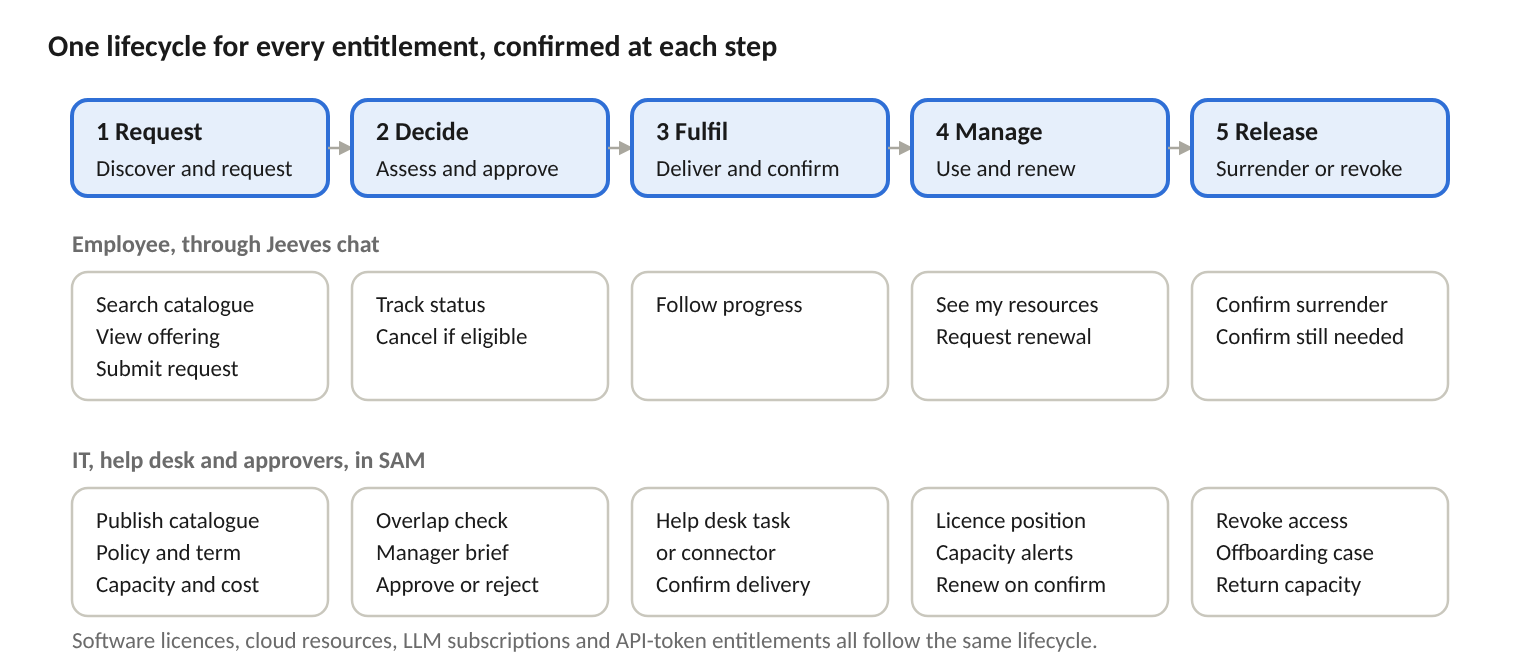
One lifecycle, two ways to work
Four resource types
| Resource | What SAM manages | Example need |
|---|---|---|
| Software licences | Offering, seat or allocation, assignment, term, renewal and release | A specialist application for a project team |
| Cloud resources | An approved resource with declared inputs, quantity or quota, and fulfilment instructions | A project environment for a defined term |
| LLM subscriptions | An approved subscription or tier, assigned to an employee for a set duration | An AI assistant subscription for a business role |
| API-token entitlements | The right or allocation for API access, its policy, quota and release (secrets stay in a separate vault) | Bounded API access for a specific use case |
What it does
Employees search the catalogue across all resource types, compare offerings, check policy, required inputs and cost or term information, and submit a request. In the same chat they can track requests, see their resources, cancel eligible requests, request renewals and confirm a surrender.
Software licences, cloud resources, LLM subscriptions and API-token entitlements share the same request, decision, fulfilment and release lifecycle, while each keeps the details it needs, such as seats, quotas, tiers or terms.
Each offering defines its resource type, required inputs, quantity or quota model, approval policy, term, capacity and cost context, and how it is fulfilled. Revisions and retirements change future offerings while keeping past requests readable.
Every request is checked against what the employee already has, has requested or has in progress. A clear overlap sends the request for manual review rather than silently rejecting it. AI similarity checks can flag a request for review but never approve or reject it. The check runs again at final submission.
Approvers receive a frozen evidence brief: resource history, overlaps, usage observations, financial estimates and anything unknown, each kept separate. Decisions go through the Jeeves approval service and are validated before they change state.
Fulfilment work carries clear instructions, ownership, progress, references and evidence. A resource only becomes active once fulfilment is confirmed. Failures and uncertain results stay visible for recovery instead of being assumed successful. Jeeves can raise a linked help desk ticket for the work.
Search and filter entitlements by employee, type, provider, state, expiry or offboarding case. Each entitlement links back to its request, decision and fulfilment. Renewals are proposed, reviewed and applied only once carried out, so access continues uninterrupted while a renewal is decided.
Employees confirm surrender of the exact prepared terms with an authenticated confirmation. Conversation text alone never removes access. Administrators can revoke under lifecycle rules. Capacity is returned once, and only when the release is confirmed.
An offboarding case captures a departing employee’s active and in-progress entitlements across all four types. Administrators review and reclaim each item, in bulk where eligible. The case closes only when every item has an accepted final outcome.
Capacity is reserved and released consistently for finite resources. Effective Licence Position snapshots show available and over-allocated positions and flag data-quality issues. Configurable capacity alerts include thresholds, cooldowns and recipients.
A prohibited-software register with reasons. CSV import of software catalogue, banned software and deployment data, with preview and validation. Location licensing covers employee country, contract territories, shared or country pools and recorded exceptions. Full audit history throughout.
Approved, effective-dated pricing and allocation terms with their sources. Allocated cost, reusable capacity, potential savings and verified spend reductions are reported separately. Missing prices or terms are shown as unknown, never as zero.
Software activity observations from IPDigital Telemetry are imported with their source, freshness and coverage. Targeted reviews ask employees to confirm they still need a resource, defer, or request surrender. No response is never treated as consent to remove access.
A provider adapter framework covers provision, status, renew, rotate, revoke and reconcile. Each adapter declares what it supports, and credentials stay in a separate vault. Manual fulfilment works wherever no connector exists. Work is tracked durably with safe retries, health monitoring, and operations briefings exported to Excel and PDF.
What sets SAM apart
Most licence tools count seats. SAM connects every resource to the person, the decision and the confirmed work behind it, and keeps estimates and facts apart.
Nothing counts as done until it is confirmed. Approval is not delivery, and a ticket is not removal. A resource becomes active only after confirmed fulfilment, and capacity returns only after a confirmed release. Retries never allocate or release twice, and uncertain provider results stay visible until they are resolved.
One lifecycle for software, cloud, AI and API access. Software seats, cloud resources, LLM subscriptions and API-token entitlements are requested, approved, delivered, renewed and released the same way. This brings the fast-growing spend on AI tools under the same control as traditional licences.
Decisions with the evidence attached. Every approval can carry a frozen manager brief covering what the employee already has, what the usage data actually shows, what it costs, and what is unknown. Decisions can be explained later.
Honest numbers for finance. SAM never confuses a returned seat with a saving. Allocated cost, reusable capacity, potential avoided purchases and verified spend reductions are kept separate, and unknowns are never turned into zero. Ten seats surrendered on a fixed monthly contract show as ten reusable seats, not a cash saving.
Usage data informs, it never revokes. Telemetry observations come with their freshness and coverage limits. A sampled absence of use can prompt a conversation with the employee, but it cannot remove access. Removal always needs the employee’s explicit, authenticated consent or an administrator’s authorised decision.
Built for the help desk that does the work. Manual fulfilment is fully supported, with instructions, ownership and evidence, so SAM delivers value from day one without waiting for vendor connectors. Connectors can be added where they declare the operations they support.
Who it is for
| Role | What they gain |
|---|---|
| Employees | Find approved resources, request access, track progress and manage renewals or surrender, all in Jeeves. |
| IT administrators | Govern the catalogue, allocate capacity, manage entitlements and reclaim resources when people leave. |
| Help desk staff | Work from explicit instructions, record progress and evidence, and resolve exceptions. |
| Managers and approvers | Decide with the business need, existing resources and a frozen evidence brief in view. |
| CFO and finance | Review the financial basis of resource use, separate reuse from cash savings, and prepare renewal discussions. |
| Integration owners | Add employee channels and execution connectors without rebuilding the resource lifecycle. |
Measuring the value
Set a baseline and compare the same measures after adoption:
Time from request to confirmed fulfilment, and status enquiries per request
Age of help desk work, and failure and rework rates
Open items and time to close entitlement offboarding cases
Approval turnaround and completeness of decision evidence
Coverage of approved cost data, and verified commercial reductions at renewal
SAM provides resource and financial context; procurement, invoicing, accounting and enterprise FinOps stay with specialist systems. Usage evidence currently covers software. Licence position snapshots support operations but are not a certification of vendor compliance. Named vendor connectors are delivered per project; manual fulfilment is supported throughout. Examples are illustrative.